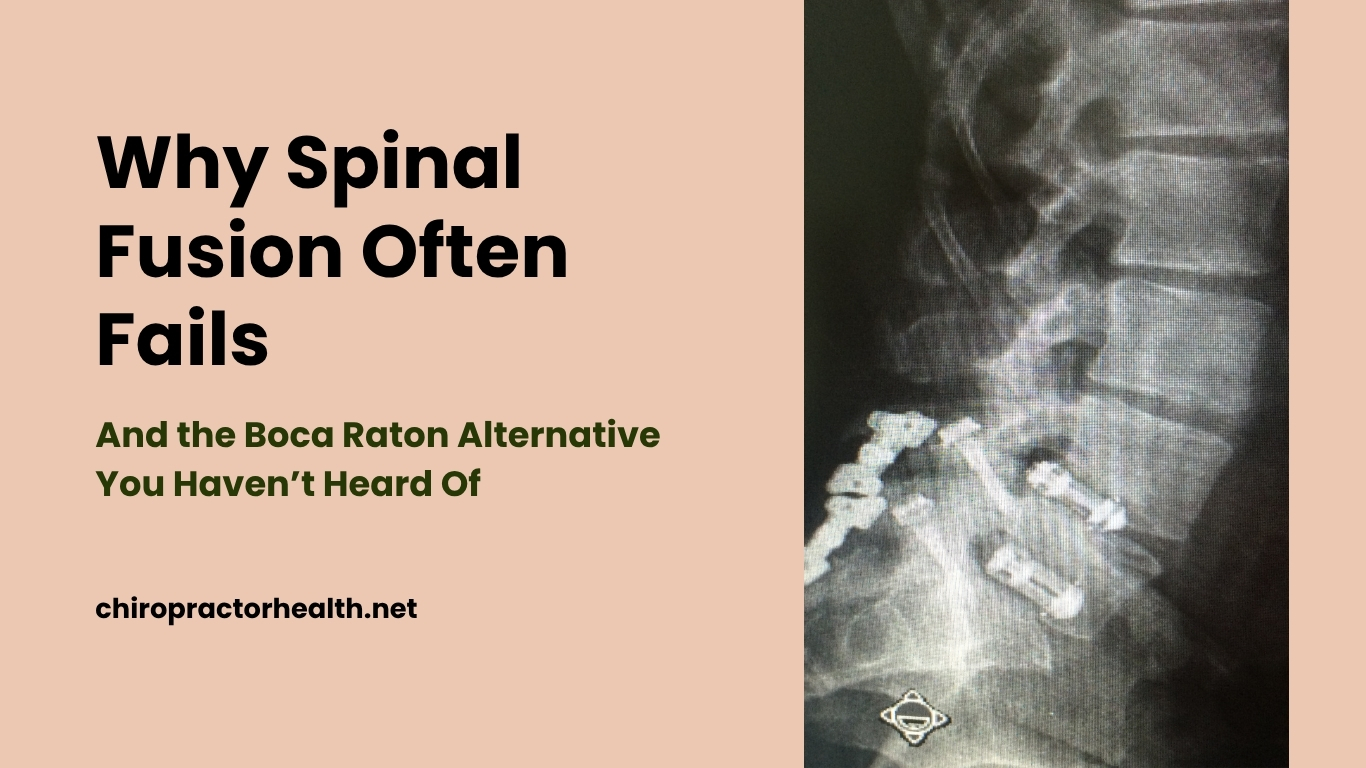
Why Spinal Fusion Often Fails—And the Boca Raton Alternative You Haven’t Heard Of
Why does spinal fusion fail? Spinal fusion often fails due to "Adjacent Segment Disease," where fused vertebrae force the next disc to overwork and bulge. Dr. Marjan Kaveh uses Chiropractic Neurology to fix the underlying "software" (muscle firing patterns), providing a research-backed alternative that preserves spinal mobility.
If you are struggling with a herniated or bulging disc in Boca Raton or Delray Beach, you have likely reached a crossroads. You’ve tried the injections. You’ve tried the standard physical therapy. Maybe you even saw a “quick crack” style chiropractor. Now, a surgeon is suggesting you bolt your spine together.
The idea of "spinal fusion" sounds like a permanent fix. But as a Chiropractic Neurologist, I see the aftermath of these surgeries every week. Patients come to my clinic on South Dixie Highway still in pain, often worse than before. In the medical world, we call this Failed Back Surgery Syndrome (FBSS).
To understand why this happens—and how to avoid it—we have to look at the research that most surgeons don't discuss during your consultation.
The Research: Why the "Hardware" Fix Fails
When you fuse two or more vertebrae together, you aren't fixing the spine; you are changing its mechanics. The spine was designed to move. When you eliminate that motion in one segment, the segments above and below it have to work twice as hard to compensate.
This leads to a condition called Adjacent Segment Disease (ASD). According to landmark research published in The Journal of Bone and Joint Surgery, the incidence of redo-surgery due to ASD can be as high as 25.6% within ten years of the initial fusion. As the researchers noted, the development of new disease at the next level occurs at a nearly constant rate of 2.9% per year.
Essentially, by "fixing" one disc with hardware, you are often fast-tracking the next disc for a blowout.
The "Software" Problem: Why Discs Bulge to Begin With
Most people think a disc herniation is a random accident. It isn't. Discs typically bulge because the muscles meant to stabilize the spine have stopped firing.
Research in PubMed highlights a critical connection between chronic back pain and multifidus muscle atrophy. The multifidus is the tiny, powerful muscle that keeps your vertebrae in place. When your brain stops sending clear signals to these muscles—a process called arthrogenic muscle inhibition—the "software" of your body is essentially glitched.
As the research suggests, "the central nervous system intentionally inhibits muscle activity" to protect a painful joint, but this creates a cycle of weakness that leaves your discs vulnerable. If you fuse the bones (the hardware) but I don't help you fix the brain's signal to the muscles (the software), the instability will just move to the next available joint. This is why adjustments often don't "stick" and why surgeries often fail to provide long-term relief.
The 14mm Success Story: Stabilizing the "Unfixable"
I want to share a case that demonstrates how clinical neuroplasticity can outperform a surgeon's knife. I treated a local farmer who presented with a 14mm spondylolisthesis. For those who haven't seen an MRI, a 14mm slip is severe. His spine had shifted forward so far that multiple specialists told him surgery was his only option if he ever wanted to walk without pain again.
Instead of bolting his spine, I acted as a "Neurological Detective." We found that his brain was not communicating with his core stabilizers. We used:
Targeted Neurological Exercises: To "re-boot" the brain-to-muscle connection.
Red Light Laser Therapy: To reduce deep-tissue inflammation and speed up cellular repair.
Computerized Balance Training: To recalibrate his brain's awareness of his spinal position (Proprioception).
After 12 visits, he was completely pain-free and back to heavy labor on the farm. I didn't just change his bones; I changed how his brain managed them. This is the difference when you address the neurological root rather than just the physical symptom.
A Validated Alternative: Clinical Neuroplasticity
I follow the high-level medical validation of the Carrick Institute. My goal is to use the principles of neuroplasticity to create a "biological fusion." By strengthening the neurological signals to your spinal muscles, your body becomes capable of holding itself in alignment.
Unlike a surgical fusion, my approach:
Preserves Mobility: You keep your ability to bend and twist.
Protects Adjacent Discs: By fixing the muscle firing, I help you stop the "domino effect" of spinal decay.
Addresses the Root Cause: I fix the brain signal, not just the symptom on the MRI.
Is Your Brain Aware of Your Spine?
If you are in Boca Raton or Delray Beach and you’ve been told you need surgery, I implore you to first look at the "software" before you commit to a permanent "hardware" change.
A disc doesn't have to be the end of your active life. Your body is a complex system of neural, circulatory, and skeletal pathways. When I help you fix the communication between them, incredible healing is possible. I have seen patients who have been in pain for decades find relief once we address the brain-body connection.
Want to see if you can prevent surgery? Don't wait until you are forced into a surgical suite. Schedule your comprehensive neuro-evaluation at the Chiropractic Neurology Enhancement Center today. Let’s find out why your spine is struggling before you make a permanent change.
Dr. Marjan Kaveh, DACNB
Chiropractic Neurology Enhancement Center
1600 S Dixie Hwy Suite 402,
Boca Raton, FL 33432
____________________________________________________________________________
References & Research Citations:
Failed Back Surgery Syndrome (FBSS): StatPearls. "Failed Back Surgery Syndrome." National Library of Medicine.NCBI - WWW Error Blocked Diagnostic
Adjacent Segment Disease Study: Hilibrand AS, et al. "Radiculopathy and myelopathy at segments adjacent to the site of a previous anterior cervical arthrodesis." The Journal of Bone and Joint Surgery. Radiculopathy and myelopathy at segments adjacent to the site of a previous anterior cervical arthrodesis.
Multifidus Atrophy Research: Freeman MD, et al. "The role of the lumbar multifidus in chronic low back pain: a review." PubMed. NCBI - WWW Error Blocked Diagnostic
Arthrogenic Muscle Inhibition: Rice DA, McNair PJ. "Arthrogenic muscle inhibition: mechanisms of muscle dysfunction and high-interest targets for rehabilitation." PubMed Central. NCBI - WWW Error Blocked Diagnostic
Proprioception Definition: Neuroscience & Biobehavioral Reviews. "Proprioception: The sense of self-movement and body position." ScienceDirect. https://www.sciencedirect.com/topics/neuroscience/proprioception
Clinical Authority: The Carrick Institute for Graduate Studies. "Clinical Neuroscience and Neuroplasticity in Chiropractic Care." https://carrickinstitute.com/
